 CodePark
A full-stack developer. Interview in 12 days, 30 minutes a day.
Interview practice
that sticks.
One plan a day: interview questions, coding problems and DSA lessons. Each comes back before you forget it.
Free. No sign-up. Works offline.


For full-stack developers.
Pick your role and interview date. Each day: what’s due, your weak spots, then something new.
I'm adeveloper
- 8 reviewsClosures, Indexes, Effects and 5 more
- 1 lessonTwo pointers
- 2 problemsValid Palindrome, debounce
- 3 newNode.js › Streams & backpressure
- Closuresin 7 days
- Indexestomorrow
- Two pointersin 3 days
Prep fades. Spaced repetition brings it back.
CodePark schedules it. Got it? Back in 1, 3, 7, 14, 30, then 60 days. Missed it? Back tomorrow.
Weak at DSA?
DSA for beginners.
18 beginner lessons in plain words, one per pattern: the idea, a template, a worked example. Press Play.
- Watch it run. Each pattern has a visual you step through, and it stops to ask what happens next.
- Plan before you code. Name the pattern and how you'll use it, then write the code.
- Hints that don't spoil it. The pattern first, then the approach, then a skeleton, then nearly there.
- Beat the clock. Every problem has a target time, like a real interview.
Read the first lessonThen 62 DSA problems, grouped by pattern.
Try it here.
The real question views and editor: an open question, a multiple choice, a coding problem. Nothing is saved.
Example · nothing is saved
loading the demo…
Frontend, React and Node.js interview questions.
From 1,617, each with a model answer and the key points.
Frontend · JavaScript
Explain hoisting and the temporal dead zone (TDZ).
Frontend · JavaScriptWhat is a closure? Give a practical example.
Frontend · ReactWhat is the difference between props and state?
Frontend · ReactWhat are the rules of hooks, and why do they exist?
Frontend · Next.jsWhat does Next.js add on top of plain React?
Frontend · Next.jsHow do you fetch data in the App Router?
Frontend · TestingHow do you test a component that shows a loading state, then fetched data?
Frontend · TestingWhat's the difference between a mock, a stub, a spy and a fake?
Frontend · TypeScriptWhat is narrowing? List the main ways to narrow a union type.
Frontend · TypeScriptName the built-in utility types you use most and what each one does.
Frontend · CSS & HTMLWhat is semantic HTML and why does it matter? Give examples of semantic elements.
Frontend · CSS & HTMLExplain the main axis and cross axis in Flexbox. Which properties align along each?
Backend · Node.js
Is Node.js single-threaded? How does it handle many concurrent requests?
Backend · Node.jsDescribe the phases of the Node.js event loop.
Backend · NestJSWhat is NestJS, and why would a team pick it over plain Express?
Backend · NestJSWhat is a guard in Nest, and why is it a better place for authorization than middleware?
Backend · DockerWhat is the difference between a container and a virtual machine?
Backend · DockerHow does the Docker build cache work, and what invalidates it?
Backend · Redis & cachingWhy is Redis so fast, and is it really single-threaded?
Backend · Redis & cachingName the main Redis data types and give a typical use case for each.
Backend · Databases & SQLWhat is a database index, and how does a B-tree index find rows?
Backend · Databases & SQLWhat does ACID stand for? Explain each property with a money transfer example.
Backend · HTTP & API designWhat are the core principles of REST?
Backend · HTTP & API designCompare offset pagination and cursor pagination for an API. When would you choose each?
A full-stack plan uses all three. Switch any on later.
Frontend
619 questions in 11 topics
- JavaScript, TypeScript, React and Next.js
- CSS & HTML, accessibility and internationalization
- Browser & web performance, testing and security
- Frontend system design
Backend
998 questions in 16 topics
- Node.js, NestJS, JavaScript and TypeScript
- Databases & SQL, Redis & caching, message queues
- HTTP & API design, auth & security
- System design, Docker, AWS and Linux
Coding
103 problems and 18 lessons
- 34 JavaScript problems, like debounce, Promise.all and deep clone
- 62 DSA problems, grouped by pattern
- 7 class design problems, in parts
- 18 beginner lessons
Built for practice.
Progress and weak spots.
Your weakest topics come first.
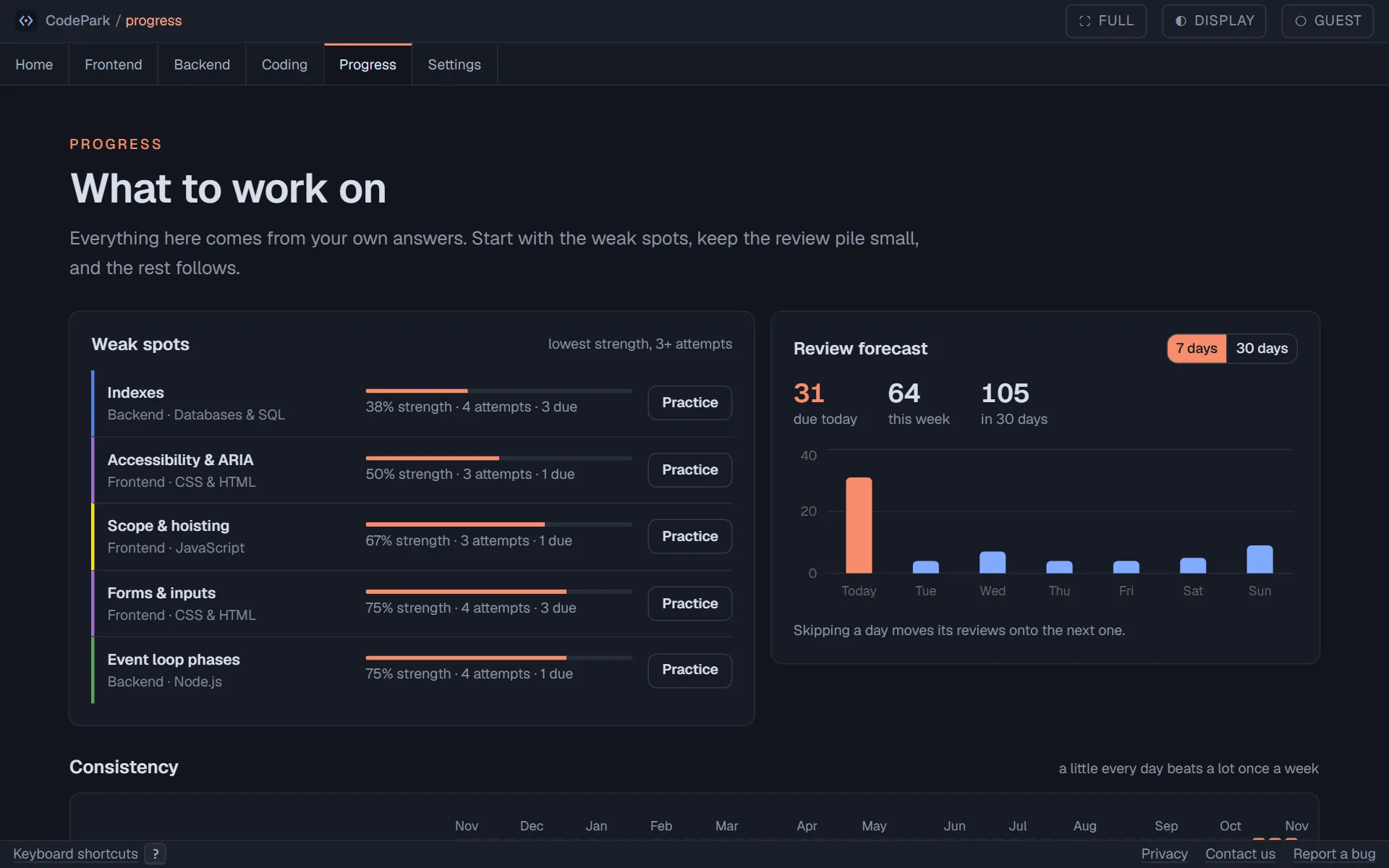
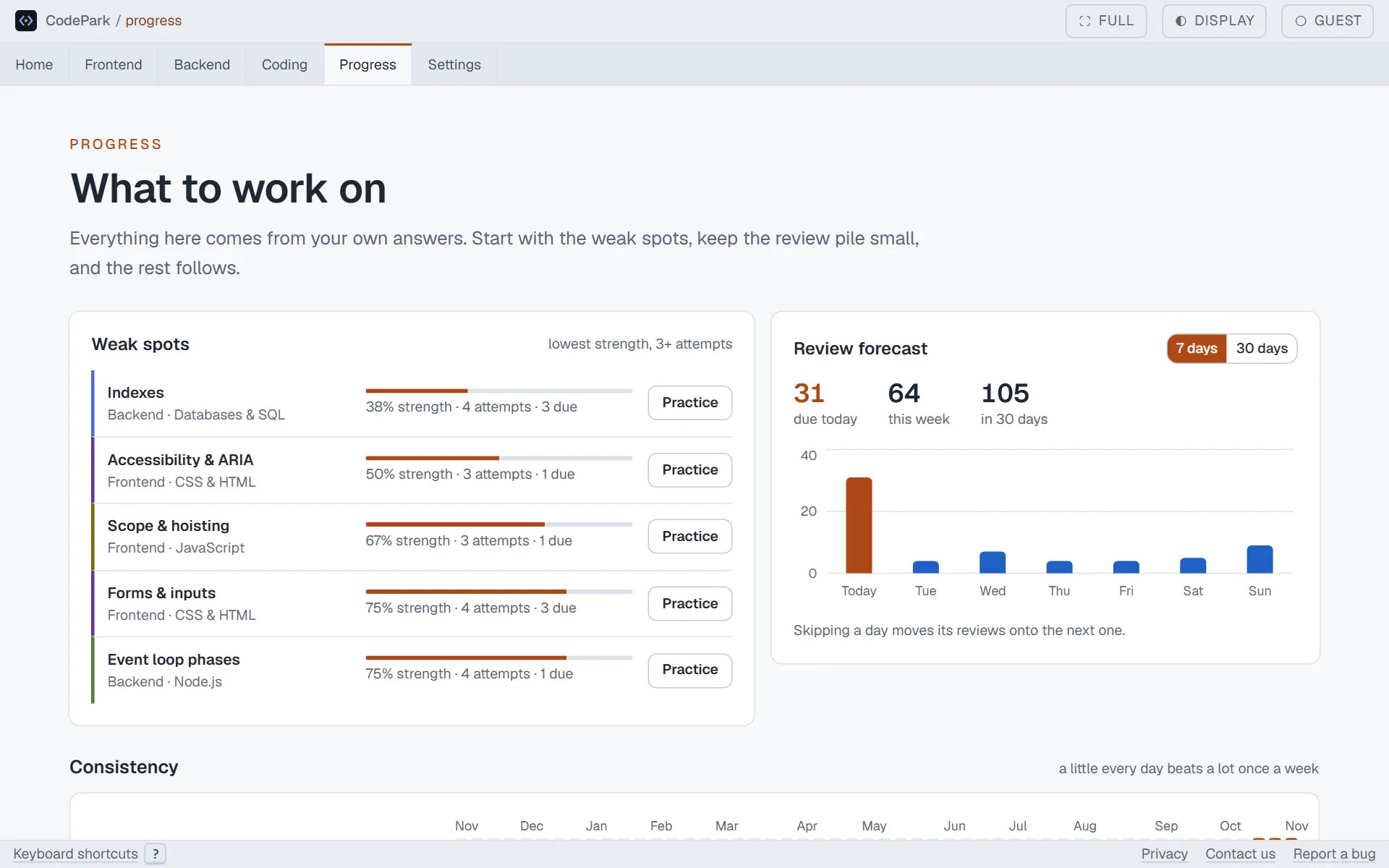
An example: thirty weeks of practice.
Review on your phone.
Lessons and reviews fit a phone.
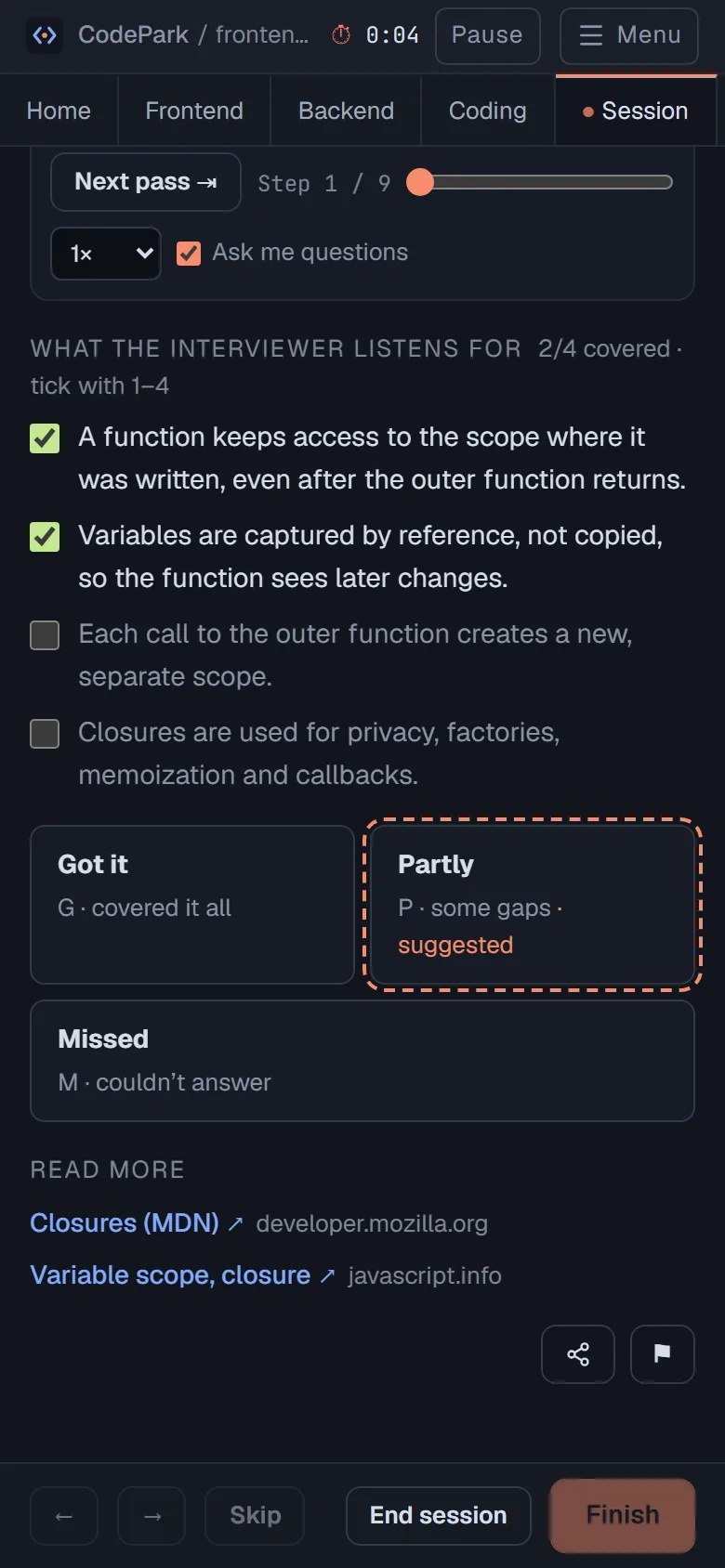
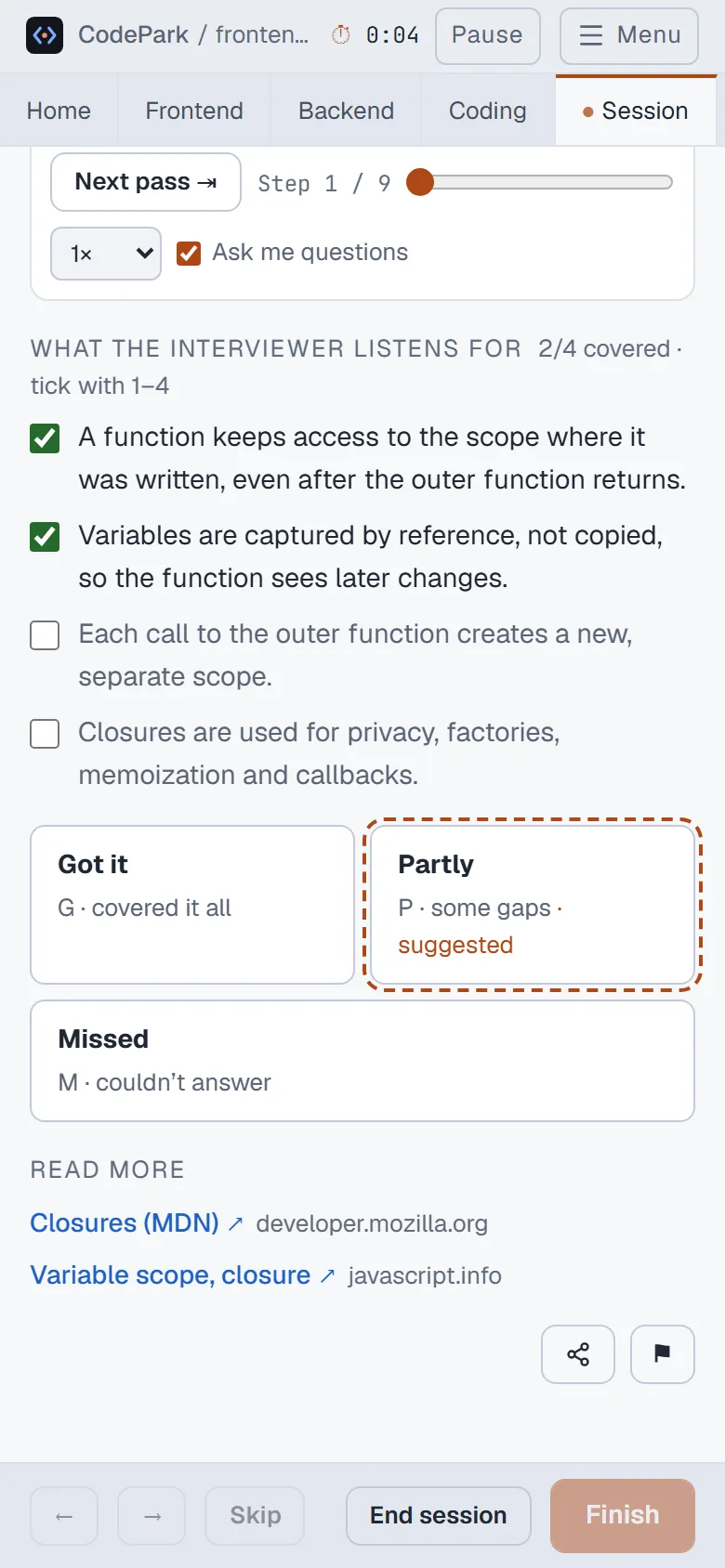
Works offline.
Install it from your browser.
Your editor, your colors.
Light, or VS Code’s with TypeScript.
Share a question.
Every page has its own link.
Backups.
Download your progress any time.
Why I built CodePark
I’m a frontend and full-stack developer, and DSA was always my weak spot. I’d solve a problem, feel good about it, and three weeks later look at the same problem with no idea where to start.
Interview questions went the same way. I’d cram them before an interview and they’d be gone a month later. The problem wasn’t learning. It was keeping it.
So I built what I wanted: one plan a day, lessons that start from zero, and reviews that bring things back just before they fade. It’s free, and it will stay free.
Omar · built CodePark
Your progress is yours.
- As a guest, your progress stays in your browser.
- Accounts are optional: sync with GitHub or Google, delete any time.
- No ads, and no ad cookies.
- Usage reports are anonymous, and off with Do Not Track.
Questions, answered.
Is it free?
Yes. All questions, problems and lessons are free and stay free. Features marked “Pro, free during beta” are free for now and will become part of Pro later, which also adds AI feedback.
Who is it for?
Developers getting ready for frontend, backend or full-stack interviews in JavaScript or TypeScript. The DSA lessons start from zero.
Does it cover React, Node.js and TypeScript?
Yes. Frontend covers JavaScript, React, Next.js, TypeScript, CSS and HTML, browser performance and frontend system design. Backend covers Node.js, NestJS, databases and SQL, API design, Redis, Docker and system design.
Can I practice LeetCode-style problems in JavaScript?
Yes. The DSA problems are grouped by pattern, like two pointers and sliding window, and each pattern has a beginner lesson. There are also JavaScript utilities, like debounce and throttle, as asked in machine coding rounds. You write the code in the browser and the tests run there.
How does spaced repetition help with coding interviews?
You forget most of what you practice within a few weeks. CodePark brings each question and problem back just before you would forget it: after 1, 3, 7, 14, 30, then 60 days. Miss it, and it comes back tomorrow.
My interview is in two weeks. Is that enough?
Set the date and CodePark fits each day to the time left. It starts with the must-know questions and your weakest topics.
Do I need an account?
No. Start as a guest and your progress stays in this browser. Sign in with GitHub or Google to sync it across devices.
Can I use it on my phone?
Yes, for lessons, questions and reviews. Coding works best on a bigger screen.
Does it work offline?
Yes. Install it from your browser and it keeps working without a connection.
Which languages?
JavaScript and TypeScript. The tests run in your browser.
Where is my data?
As a guest, only in your browser. Signed in, on CodePark's server, where you can download or delete it at any time.